
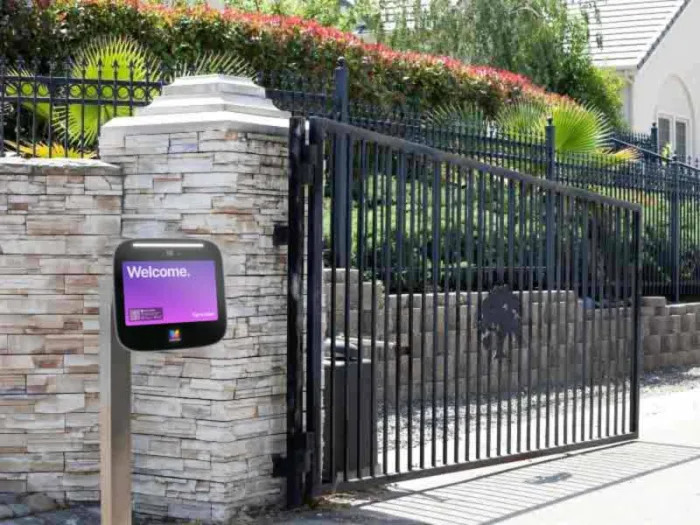





Key takeaways:
- Choose a gate by measuring the site first: opening width, runback, swing arc, overhead clearance, grade, weather exposure, and expected traffic cycles all matter.
- A gate mechanism does not determine security on its own. The frame, infill, posts, foundation, site design, and any required crash testing matter too.
- An automated entrance has three layers: the physical gate, the operator that moves it, and access control that decides who can enter.
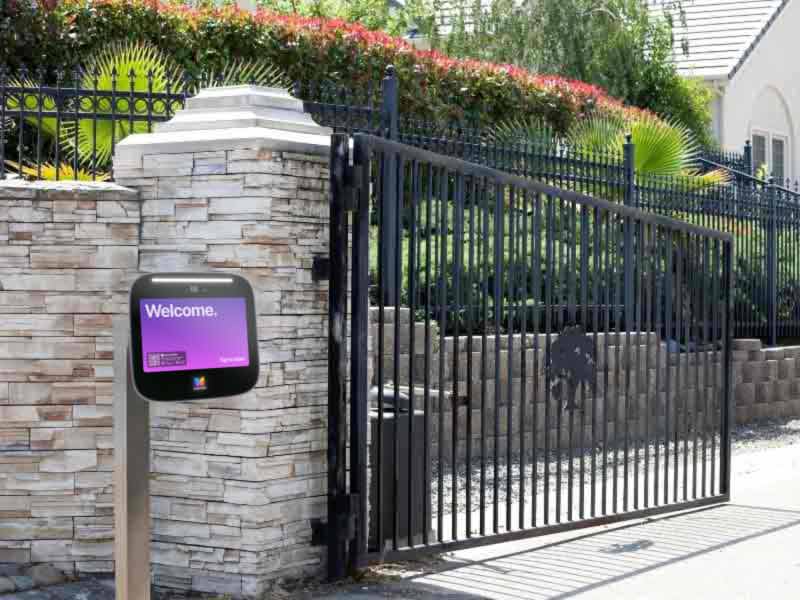
Choosing among the many types of security gates is less about finding a universal winner and more about matching a gate to the property in front of you. A swing gate needs room to move through an arc. A sliding gate needs room beside the opening. A vertical gate needs clear space above it. Then there are practical questions about weather, traffic, pedestrians, emergency access, maintenance, and the level of physical resistance the site requires.
The main types of security gates are swing, rolling slide, cantilever slide, vertical lift, vertical pivot, bi-fold, overhead slide, and telescoping gates. Barrier arms and dedicated pedestrian gates also play important, but different, roles. This guide explains how each gate access option works and how property teams can build a realistic shortlist before requesting quotes or choosing access technology.
This guide will answer:
- Main types of security gates and how they differ
- The gate, operator, and access control stack
- How to match a security gate to the site
- Barrier arms and dedicated pedestrian entrances
- What determines security and crash resistance
- Safety standards and emergency access for automatic gates
- Traffic, tailgating, outages, and maintenance
- Security gate costs and quote components
- How access control completes a gated entrance
- FAQs
Watch how ButterflyMX works:
Main types of security gates and how they differ
The main vehicular gate types are swing, rolling slide, cantilever slide, vertical lift, vertical pivot, bi-fold, overhead slide, and telescoping gates. Barrier arms control vehicle lanes but do not close an opening in the same way as a full gate. Dedicated pedestrian gates, turnstiles, portals, and folding pedestrian gates address foot traffic separately. Use the comparison below to eliminate options that do not fit the site, not to select a universal winner.
Swipe to compare →
A comparison of commercial gate mechanisms highlights why footprint, grade, and operating conditions should drive this early screening. Exact dimensions, foundations, and clearances depend on the selected product and the property.
Rolling slide gates versus cantilever gates
A rolling slide gate rides on a ground track. A cantilever slide gate crosses the opening without a ground track, using a counterbalanced section that extends beyond the clear opening. In practical terms, a rolling gate may be a fit where a maintainable track and drainage are realistic. A cantilever gate can avoid track exposure to debris, snow, and ice, but it needs more side runback. Manufacturer and installer guidance consistently treats both conditions as site-specific constraints.
Limited side space does not automatically point to one gate type. A vertical design may help if there is clear overhead room. A slide gate avoids a swing arc, but it still needs adequate runback. A site survey should confirm these conditions before a property commits to a mechanism.
The gate, operator, and access control stack
A gated entrance has three separate layers. The gate is the physical barrier. The gate operator is the equipment that moves an automated gate. Access control is the decision layer that determines whether a resident, visitor, delivery driver, employee, or service provider may enter.
A manual gate can work for a low-use entrance where staff can operate it safely. Automation adds convenience, but it also adds an operator, power, safety devices, credentials, maintenance needs, and documented procedures for failures. These layers may be supplied and serviced by different companies, so property teams should document who owns each service call.
For more detail on the decision layer, see this guide to how gate access control works. ButterflyMX can serve as a potential access-control layer after the property verifies compatibility with its specific gate operator, wiring, power, network, lane arrangement, and entry workflow. It is not the gate or the operator.
How to match a security gate to the site
Start with the site, not a catalog. A professional survey can turn a broad preference into a workable specification and prevent a property from comparing quotes for systems that cannot fit or operate as intended.
- Measure the clear opening, available side runback, swing arc, overhead clearance, and vehicle stacking area.
- Review grade, drainage, snow and ice exposure, debris, wind, and the location of utilities.
- Identify traffic patterns, expected daily cycles, lane layout, and how residents, visitors, deliveries, service vehicles, and emergency responders will use the entrance.
- Document power and network availability, as well as the desired credential and visitor-entry workflow.
- Define the physical-resistance objective. Everyday perimeter closure is different from a site with a defined vehicle-impact threat.
- Confirm safety, pedestrian routing, emergency operation, maintenance ownership, and quote scope before final budgeting.
Climate changes the tradeoffs. Ground tracks can be vulnerable to snow, ice, and debris. Large solid swing leaves can be affected by wind. Drainage can affect rolling systems, while overhead structures can rule out vertical designs. These are planning considerations, not installation instructions, and the selected manufacturer and qualified gate professional should evaluate the final conditions.
Barrier arms and dedicated pedestrian entrances
A barrier arm is a vehicle traffic-control device, not a substitute for a full physical gate. It can support an authorized vehicle-entry workflow, but it does not create the same perimeter closure or resistance as a sliding, swing, or vertical gate. Vendor commentary suggests barrier arms may be useful in certain high-traffic layouts and may be easier to reset after some strikes, but those observations do not mean they prevent tailgating or fit every site.
Pedestrians need their own route. The DASMA summary of UL 325 provisions says vehicular gate operators are for vehicular gates and calls for a separate pedestrian gate where pedestrian access is likely. A pedestrian swing gate may be appropriate in some layouts. Turnstiles, portals, and folding pedestrian gates are other possible categories, but accessibility, egress, life-safety, hardware, and local-code requirements require qualified review.
Plan readers, credentials, and intercom placement around each distinct entrance. A pedestrian door and a vehicle lane can use different access workflows, even when both are managed through the same broader access-control program.
What determines security and crash resistance
No gate mechanism is universally the most secure. A swing, slide, vertical, or folding movement describes how a gate opens. It does not establish how much resistance the complete system provides. Evaluate the frame, infill, posts, foundation, locks or latching where applicable, site design, and the threat the property is trying to address.
Most managed properties are evaluating everyday perimeter control and authorized entry. A site with a defined vehicle-impact threat may need an independently tested vehicle security barrier instead. ASTM F2656/F2656M-23 provides test methods for crash testing and penetration ratings of vehicle security barriers. The standard does not, by itself, determine whether a barrier is suitable for every site or operating condition.
When vehicle-impact protection is part of the requirement, work with qualified security and engineering professionals on the whole system. Do not treat a gate label or opening mechanism as a crash-performance promise.
Safety standards and emergency access for automatic gates
Automatic gates require planning beyond the gate leaf and operator. UL 325 identifies four usage classes for vehicular gate operators. The DASMA technical summary of seventh-edition provisions identifies Class II as commercial or general-access applications, including multifamily properties with five or more units. That summary also describes at least two independent entrapment-protection means per entrapment zone for vehicular gate and barrier-arm operators, with requirements that vary by gate type and direction.
These details should be treated as planning context, not a substitute for a current technical review. The DASMA UL 325 technical data sheet is a useful starting point, but a qualified gate-automation professional should verify the current edition, product listing, safety equipment, control placement, signs, and local requirements for the proposed system.
ASTM F2200-24 covers construction requirements for several types of automated vehicular gates and connects automated systems with UL 325 compliance. It is one part of a broader review that should also include pedestrian separation and the physical condition of the gate itself.
Emergency access must be planned with the local authority having jurisdiction. The 2024 International Fire Code states that gates across fire apparatus access roads require approval by the fire code official, an approved emergency-operation method, and ongoing operability. Because the IFC is a model code, properties should verify local adoption, amendments, and accepted devices with the local authority. Read the relevant 2024 IFC security-gate provision before finalizing the plan.
Traffic, tailgating, outages, and maintenance
Traffic planning is about more than opening speed. Throughput depends on the operator class, current product listing, configuration, lane design, credential workflow, expected cycles, and how drivers approach the entrance. Avoid choosing a gate based on a broad claim that one mechanism is always faster than another.
Tailgating occurs when an unauthorized vehicle follows an authorized vehicle through an opening. Gate design, lane layout, credentials, monitoring, and operating logic can influence that risk, but neither a faster gate nor access-control technology guarantees that tailgating will be prevented. The same restraint applies to gate strikes. Cameras and audit trails can support review of an event, but they do not ensure that a physical gate will not be hit.
Before opening day, document what happens during power loss, network loss, emergency operation, and after-hours failures. Assign a responsible contact for the gate leaf and hardware, the operator and safety devices, the access-control equipment, and visitor-management procedures. This division of responsibility makes it easier to direct a failure to the right provider rather than treating the whole entrance as one black box.
Security gate costs and quote components
Security-gate costs vary too much by location and scope for a single average to be useful. As a dated illustration, HomeGuide listed June 2026 estimates of $3,000 to $12,000 for a security gate with technology and $5,000 to $15,000 or more for a commercial security gate. It also listed $500 to $2,000 for technology integration and $100 to $300 per year for routine maintenance. These are consumer-marketplace estimates, not observed multifamily transaction data, so use them only as a starting point for questions, not as a property budget.
The June 2026 security-gate cost estimates help illustrate why a comparable quote must define what is included. Scope can vary by opening size, mechanism, construction, region, safety equipment, site work, and property type.
Compare scope, exclusions, warranties, preventive-maintenance expectations, outage support, and responsibility for future repairs. A lower headline price may omit a component that the property still needs to procure.
How access control completes a gated entrance
Once a property has selected a realistic gate category and confirmed its safety and emergency requirements, it can design the entry workflow. Start by mapping who uses the entrance: residents, visitors, deliveries, staff, service providers, and emergency responders may each need a different approved path.
Depending on the property and verified configuration, that workflow may include a gate video intercom, mobile access, PINs, fobs, license plate recognition, windshield credentials, Visitor Passes, audit trails, or security cameras. ButterflyMX video intercoms can allow residents to receive visitor calls and grant access through their smartphones, while property teams can remotely manage residents, visitors, credentials, and access. The final design must still be evaluated with the specific gate operator, site wiring, power, network, lane layout, and emergency plan.
For a closer look at the operator layer, review gate operator types and smart gate openers. Before publicizing a proposed pairing, ask qualified providers to confirm compatibility, device placement, and outage behavior for the property. Access control can authorize entry and document activity; it does not replace gate construction, operator safety, or emergency planning.
Explore access options for residents, visitors, deliveries, and vehicles after your team has narrowed the gate type and verified the operator and site requirements.
Frequently asked questions
Are automatic security gates worth it?
Automatic security gates can be worthwhile when the property needs a repeatable vehicle-entry workflow, but their value depends on traffic needs, staffing, credential workflows, safety planning, maintenance capacity, outage procedures, and the desired level of physical control. Automation adds convenience and integration options, but it also adds operator, power, safety, and service dependencies.
How often does a security gate need maintenance?
A security gate does not have one universal maintenance interval. Establish a documented inspection and preventive-maintenance plan based on the gate and operator manufacturer, safety devices, traffic cycles, climate, and service history.
Can a security gate stop vehicle tailgating?
No gate or access-control system can guarantee that it will stop vehicle tailgating. Gate design, lane layout, credentials, monitoring, and operating logic can influence the risk, but they do not eliminate it.
How do emergency vehicles get through a security gate?
Emergency vehicles need an emergency-operation plan approved by the local fire code official or authority having jurisdiction when a gate crosses a fire apparatus access road. Confirm locally accepted methods before purchasing equipment because code adoption and approved devices vary.
Can access control be added to an existing gate?
Access control may be added to an existing gate after qualified providers evaluate the operator, controls, safety system, power, connectivity, lane layout, credential workflow, and emergency operation. Compatibility should be confirmed for the specific installation rather than assumed.
The right security gate begins with the property itself. Measure the space, understand traffic and climate, separate pedestrian and vehicle routes, and establish the physical-resistance and emergency-access requirements before comparing mechanisms or prices. Then verify the operator, safety system, and access-control workflow as one coordinated entrance plan.
ButterflyMX can support the access-control layer for a gated property after site and operator compatibility are confirmed. Discuss your gated entrance and access needs with ButterflyMX to plan a workflow for residents, visitors, deliveries, and vehicles.

Get your free quote!
Fill in the form below, and we'll email you right back.
Want a free quote?
Fill in the form below, and we'll email you right back.
Redirecting you in 5 seconds.